Redesigning How Brands Define Themselves
An AI-powered advertising platform needed to understand why its most critical onboarding step — a brand identity survey — was failing users. I led a mixed-methods study of senior advertising and brand executives to diagnose the problem and translate findings into specific product recommendations.
The Problem
Sightly is an AI-powered SaaS platform that solves ad adjacency. They ensure that a brand's ads appear alongside content that fits their values, not content that would be jarring or damaging. A cosmetics brand probably doesn't want its ads next to a news article about chemical spills. A family-friendly brand needs to avoid appearing alongside divisive political content. Getting this wrong is costly, and getting it right requires the platform to truly understand each brand's identity.
To do this, Sightly built "Brand Mentality," basically a profile that captures a brand's values, sensitivities, and cultural positioning. Users create their "Brand Mentality" by completing a detailed survey about their brand's perspective on dozens of topics. The profile then drives automated decisions about where ads should and shouldn't appear.
The core problem: anyone senior enough at a brand to truly speak for its values doesn't have time for a tedious onboarding exercise. And anyone junior enough to be setting up a SaaS tool isn't authorized to make consequential calls about brand identity. The result was incomplete profiles, survey fatigue, and declining data quality. All of that was quickly undermining the platform's core value proposition.
Sightly hired me and my team to figure out how brand and advertising leaders actually think about brand identity, what was going wrong in the profile creation process, and how to fix it.
Research Design
The research question had two layers. First, a conceptual layer: how do senior brand and media strategists think about brand identity? What shapes it, how formalized is it, and how does it inform real decisions? That's what can determine how Sightly's brand profiles should be built in the first place. Second, a practical layer: what specifically is breaking in the brand profile survey experience, and what would make it work?
I designed a mixed-methods research plan that moved from broad context to specific feedback for product redesign. This process started with a short quantitative pre-survey to segment participants, then moved to in-depth semi-structured 1:1 interviews to go deeper, and then finished with a set of practical recommendations to negotiate with the product team.
Pre-Interview Survey
Short quantitative screener to assess familiarity with Sightly and Brand Mentality, prior platform experience, and role context. This let me tailor each interview and segment findings by experience level.
Semi-Structured Interviews
In-depth 1:1 interviews (remote, 45-60 min) with dozens of industry leaders spanning agency execs, brand leads, CMOs, and consultants. Covered brand perspective formation, decision-making, tool evaluation, and platform feedback.
Participant Diversity
Intentionally recruited across roles (VPs, Directors, C-suite), org types (agencies, brands, consultancies), verticals (CPG, media, sports, beauty, tech), and Sightly familiarity levels from daily users to first exposure.
Analysis
Thematic analysis identifying consistent patterns across the sample. Findings triangulated against existing research in consumer psychology and technology adoption, not treated as standalone.
One thing we found in the first stage (the pre-interview survey) was that even among current users, familiarity with the tool was pretty low. This could either be because the experience didn't seem memorable or important, or because they didn't realize that Brand Mentality tool was the onboarding questionnaire they went through.

Key Interview Findings
A Note on Interview Structure
I structured each interview in three phases. The first explored how participants think about brand identity in general (without mentioning Sightly) to get uncontaminated mental models. The second introduced Brand Mentality and gathered reactions, perceived value, and concerns. The third (for experienced users only) went deep on the brand profile survey UX. This sequencing prevents the product framing from biasing how people describe their own thinking — a common failure mode in product research.
1. Brand Identity Is Important but Rarely Codified
There was near-universal agreement that a well-defined, formalized brand perspective is extremely valuable. It allows faster responses to cultural moments and more consistent decision-making across teams. But most brands don't actually have one in place. What exists is usually a vague mission statement. They usually just have some PR-polished aspirational language about what the brand wants to be, not any operational guidance about how to act in specific situations.
This gap between recognizing the value of a codified brand identity and actually having one is precisely the space that our client's product fills. The brand profile doesn't need to just be a tedious onboarding step. It could instead be a standalone asset that many brands don't have and would pay for independently. Several participants identified this as Sightly's primary differentiator.
Note: This idea became an entire new organizational priority for our client. They are now actively selling the formalization of a brand identity as one of their core product features.
The data also showed that brand perspective is shaped primarily by two forces: the internal values of the company (leadership vision, brand heritage) and the values of the target consumer. When these conflict, consumer values almost always win. Notably absent from participants' mental models were broader forces like industry trends or competitor positioning. Brand identity is built close to home.
2. Risk Aversion Dominates Decision-Making
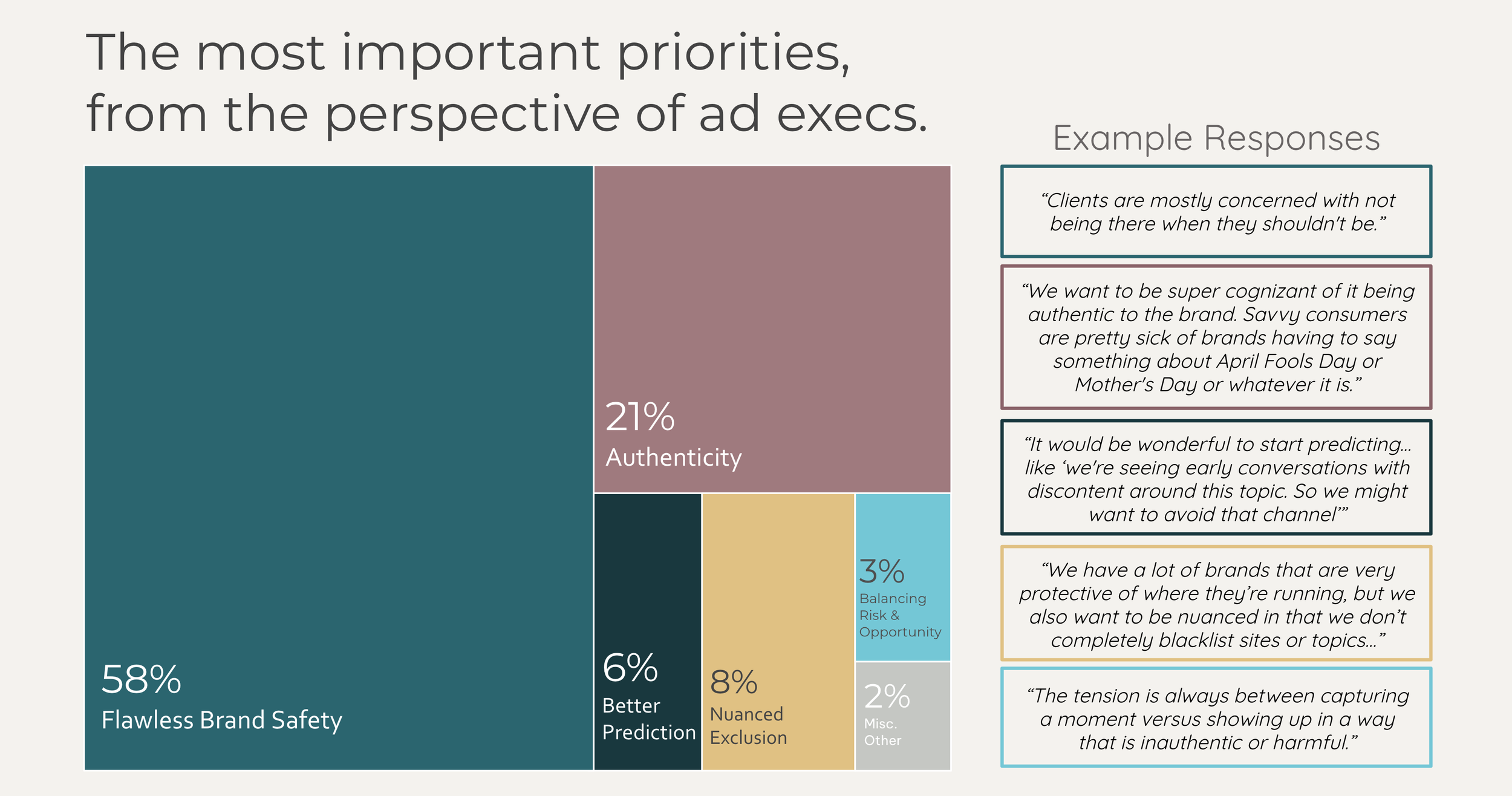
Across nearly every interview, regardless of role or vertical, the advertising execs described their brands as fundamentally risk-averse. The asymmetry was stark. Agencies are punished when an ad appears in the wrong context but rarely rewarded when placement is excellent. This creates a powerful incentive structure favoring avoidance over opportunity.
"The only time clients notice is if someone catches an ad running where it shouldn't. They're never like 'Oh this ran in this great article, good job!'"
— VP, Media Director at a major agencyThis finding had direct product implications. Sightly's pitch should lead with flawless brand safety. Brands want nuanced, granular exclusion of adjacency dangers rather than blunt domain-level blocking. And even imprecise safety is more important than chasing opportunities for cultural engagement. Users want a scalpel, not a megaphone. And they want 100% guaranteed safety.
3. The Brand Profile Survey Is the Critical Bottleneck
From a product perspective, the most immediately actionable findings came from users with experience in the brand profile creation process. Five distinct pain points emerged consistently:
Pain Point
Excessive length. The survey was described as overwhelming — a major task right at the onboarding gate. One user reported they could feel their own data quality "decaying over time because of the duration." Multiple participants said anything over 20 minutes would deter adoption.
Recommendation for product team
Modular architecture with display logic. Restructure into skippable topic modules (similar to TurboTax routing). Initial screening questions determine which modules are relevant, reducing both actual length and perceived tedium from irrelevant questions.
Pain Point
Opaque consequences. Users didn't understand what their answers actually did. They didn't know how a response would translate into ad placement decisions. They were making blind choices on high-stakes brand safety questions.
Recommendation for product team
Real-time examples and impact previews. Use tool tips and other features to show concrete examples of what each answer means in practice (e.g., "Selecting 'avoid' means your ads won't appear alongside content like [example]"). Make the whole process feel like strategic decision-making, not form-filling.
Pain Point
Categories too broad. Labels like "Sports" or "monitoring" were confusing. Users couldn't make good decisions because concepts were too vague or used unfamiliar platform-specific jargon.
Recommendation for product team
Granular subcategories with plain-language labels. Break broad categories into meaningful sub-topics. Replace jargon with clear descriptions. Consider aligning with the industry-standard GARM framework, which participants already know and trust.
Pain Point
Wrong person filling it out. Agency-side users often didn't know the brand's true position on sensitive topics. Brand-side executives who did have this ability lacked bandwidth. The result was guesswork on consequential decisions.
Recommendation for product team
Collaborative workflow with role-based access. Agencies draft the profile, brands approve question by question. Include a prep guide. Target mid-level brand management: senior enough to know the perspective, available enough to do the work.
Pain Point
AI-generated profiles lacked nuance. Auto-populated profiles from website content produced plausible but superficial results. For example, flagging a brand as sustainability-focused simply because the site had a sustainability page, when that wasn't a core value or a true trait.
Recommendation for product team
AI as draft, human as editor. Position the AI tool explicitly as a time-saving starting point that requires correction. Alert users that AI over-indexes on surface signals and their expertise is needed to capture actual priorities.
4. Self-Service Needs More Support Than Expected
Sightly was planning a self-service offering, and I specifically probed participants on this. The consensus was that a hybrid model is necessary. Even those who preferred self-service acknowledged that most users won't extract full value without guidance. There was strong agreement about the tool's capability, but the problem was the distance between what the tool can do and what unsupported users will actually do with it.
"What Sightly is building is a Ferrari. But most of the media leads or brand marketers only know how to drive a Chevy."
— Independent consultant, former 20yr agency executive"I think a hybrid model would be best. I could see a self-service model working for some clients on a much wider basis, but for some clients, there’s comfort in a white glove service where there is someone there who is inputting and handling your information. You have someone to speak to.."
— VP Enterprise Sales, major ad agencyI recommended that even the self-service tier include structured onboarding tutorials, periodic check-ins, reminders about unused features, and a "profile health" indicator flagging stale or incomplete profiles. All of these can reduce the gap between potential and actual user experience.
Translating Research Into Product Strategy
In addition to collaborating with the product team on my specific product redesign recommendations, I also presented Sightly's C-suite and board with three higher-level ideas about strategic direction.
Reposition the brand profile as a standalone value proposition. Most brands don't have an operationalized identity document. The brand profile is currently framed as an onboarding requirement. But the data is telling us it is far more valuable than that. It should be framed as a deliverable in its own right. Several participants said this was Sightly's strongest differentiator, and some suggested it could be offered as its own professional services engagement.
Lead with precision safety, not cultural opportunity. The industry is overwhelmingly risk-averse. Sightly's ability to provide nuanced, case-by-case content evaluation — rather than crude domain-level blocking — is far more compelling than promises of cultural relevance. Frame the tool as enabling surgical brand safety that doesn't sacrifice reach.
Build the ROI proof before scaling. Multiple participants couldn't justify the tool's adoption cost without clearer evidence of outcomes. I recommended prioritizing A/B testing infrastructure and brand-lift measurement so early adopters could generate the case studies needed to convince risk-averse buyers.